

Renovating a bathroom is one of the most exciting, yet complex, projects Australian homeowners undertake. We dream of the finishes: the floor-to-ceiling porcelain tiles, the frameless glass shower screen, and the matte black tapware. However, the most critical part of a bathroom renovation is invisible once the project is finished. It lies beneath the tiles.
Water is the enemy of any home structure. If it doesn’t drain away correctly, it sits, stagnates, and eventually seeps into places it shouldn’t go. This leads to mould, rotting timber frames, and expensive structural damage. The secret to preventing this disaster is effective shower screeding.
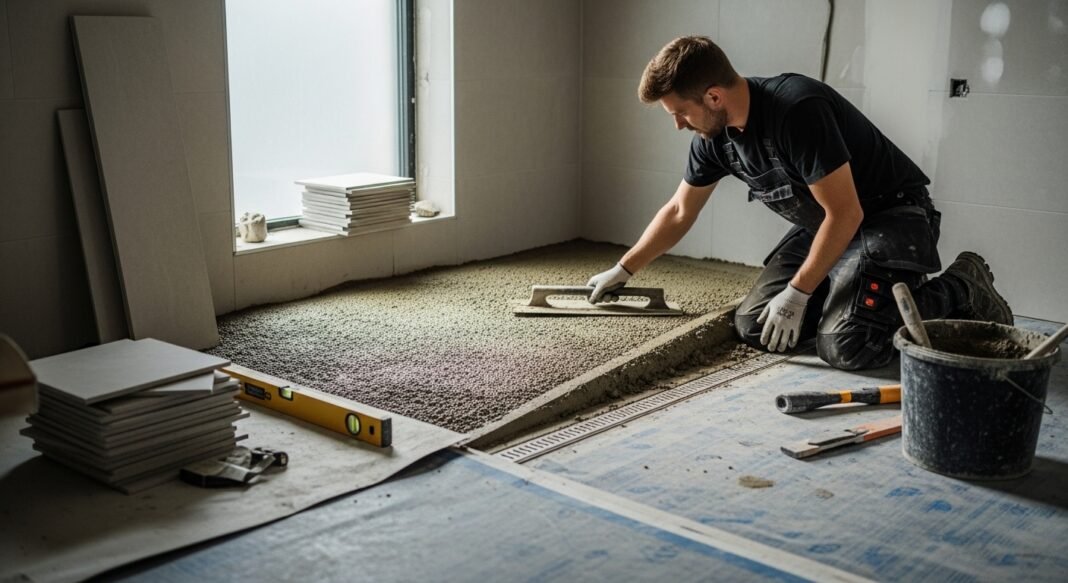
A screed is simply a layer of sand and cement placed on top of the structural floor (concrete or timber). Its primary job in a shower is to create the perfect slope—or “fall”—that directs water straight to the drain. Without a properly installed screed, water will pool on your beautiful new tiles, creating a slip hazard and a hygiene nightmare.
This guide dives into the technical but vital world of screeding, explaining why precision matters and how it integrates with waterproofing to keep your Australian home dry and safe.
Understanding the “Fall”
In Australia, the Building Code (AS 3740) is very specific about drainage. Water must not be allowed to pond on the floor of a wet area.
To achieve this, the floor needs a gradient.
- Shower Areas: The fall must be between 1:60 and 1:80. This means for every 60mm to 80mm of distance, the floor level must drop by 1mm.
- General Bathroom Floor: The fall should be between 1:80 and 1:100 towards the floor waste.
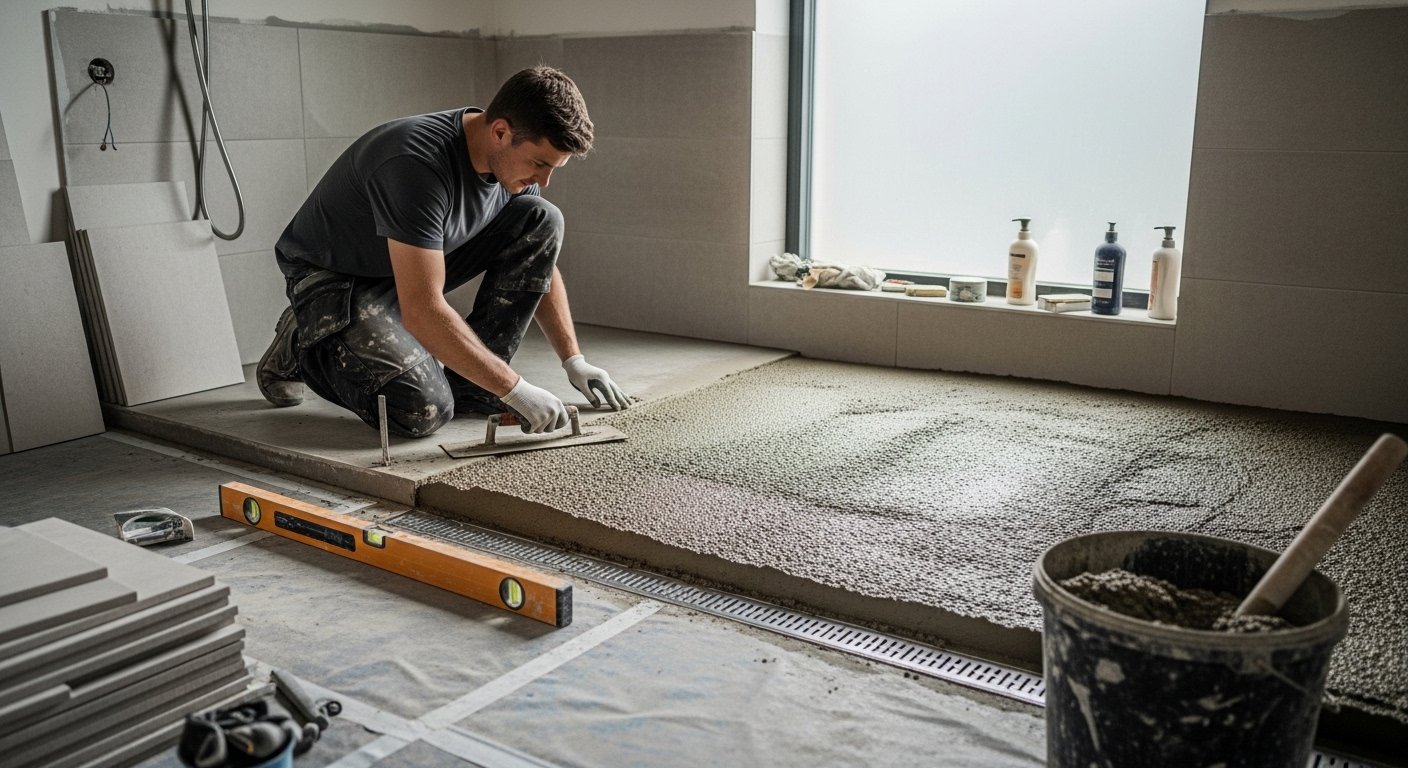
Achieving these ratios requires skill. If the slope is too steep, it feels uncomfortable to stand on. If it is too shallow, the water won’t move. Shower screeding is the art of hand-troweling a sand and cement mix to create this precise slope. It acts as the sculpted base upon which your tiles are glued.
Traditional vs. Bonded vs. Unbonded Screeds
Not all screeds are installed the same way. The method used depends on the construction of your home and the thickness required.
Bonded Screed
This is the most common method for residential bathrooms. A bonding agent (a slurry of cement and additives) is applied to the concrete slab, and the screed mix is placed directly on top while the agent is still wet. This “bonds” the screed to the slab, making them one solid unit. It is ideal for thinner layers where height is an issue.
Unbonded Screed
In this method, a plastic membrane sits between the concrete slab and the screed. This allows the screed to “float” independently of the slab. Why do this? Because concrete slabs move and crack over time. By uncoupling the screed, cracks in the slab won’t travel up through the screed and crack your tiles. This is often used in larger commercial areas or homes with reactive soil.
Reinforced Screed
For extra strength, wire mesh or fibres are added to the mix. This is crucial for shower screeding over timber floors or in areas where the screed needs to be thicker than usual (over 40mm).
The Vital Link: Screeding and Waterproofing
This is where many DIY renovations fail. The relationship between the screed and the waterproof membrane is critical.
There are two main ways to waterproof a shower:
- Under the Screed: The membrane is applied to the structural floor first. The screed is then laid on top. This protects the structure of the house, but the screed itself (which is porous) will get wet. Water soaks through the grout, fills the screed, and drains away via “puddle flanges” in the drain.
- Over the Screed: The screed is laid first to create the slope. Once dry, the waterproofing membrane is painted over the top of the screed. The tiles are then glued directly to the membrane.
In modern Australian bathrooms, the “Over the Screed” method is becoming preferred. Why? Because it keeps the screed dry. If the screed stays dry, you don’t get efflorescence—that white, salty crust that seeps out of grout lines. It also prevents smells caused by stagnant water sitting in the screed layer.
Preparing for Installation
Before a single bucket of mix is poured, the preparation must be perfect.
Substrate Cleanliness: The concrete or timber floor must be spotless. Dust, plaster droppings, and oil will stop the screed from bonding. A thorough vacuum and wash are essential.
Puddle Flanges: The drain is the heart of the shower. A puddle flange must be installed at the lowest point. This is a special fitting that sits flush with the floor, allowing any water that penetrates the tiles to drain away safely into the pipe, rather than leaking into the subfloor.
Setting the Levels: Professional tilers use laser levels to mark the finished floor height on the walls. They calculate the thickness of the tile, the glue, and the screed to ensure the final floor level matches the carpet or floorboards in the hallway perfectly.
Mixing the Perfect Screed
The mix for shower screeding is drier than concrete. It is often called “semi-dry” or “earth moist.” It consists of sharp sand and cement (usually at a 3:1 or 4:1 ratio).
The consistency is key. If you squeeze a handful, it should hold its shape like a snowball without dripping water. If it is too wet, it will shrink and crack as it dries. If it is too dry, it won’t be strong enough and will crumble under the tiles. Experienced tradespeople know exactly how much water to add based on the humidity and temperature of the day.
Curing Times: Patience is Necessary
In the rush of a renovation, waiting is hard. But walking on a screed too early ruins it.
- Standard Screed: Generally needs at least 24 hours to set enough for foot traffic and up to 7 days to cure fully before waterproofing can be applied. If you waterproof over a wet screed, the moisture gets trapped and will cause the membrane to bubble and fail.
- Engineered/Rapid Screed: For tight schedules, special additives can be used to speed up the drying time, allowing tiling to commence in as little as 24 hours.
Tiling on Top
Once the screed is cured and waterproofed, it provides the perfect canvas for tiling. Because the floor is now perfectly flat and sloped correctly, the tiler can use a thin bed of adhesive. This saves money on glue and ensures the tiles sit flush with no lippage.
For the shower floor specifically, the tile choice matters. Large tiles require “envelope cutting” (diagonal cuts) to follow the slope of the screed towards the drain. Many Australians opt for mosaic tiles or smaller formats in the shower recess because they can naturally follow the curves of the screed without complex cutting.
Questions and Answers: Common Questions About Shower Screeding in Australia
Q: Can I screed my own bathroom floor?
A: It is possible for a competent DIYer, but it is risky. Getting the fall ratios correct to meet Australian Standards is difficult without experience. If the fall is wrong and water pools, you will fail the building inspection, and you may have to rip it all up. Given the low cost of materials versus the high cost of failure, hiring a professional for shower screeding is highly recommended.
Q: How thick should the screed be?
A: The minimum thickness for a bonded sand and cement screed is usually 15mm at the thinnest point (at the drain). It then gets thicker as it moves up the slope towards the walls. For unbonded screeds, the minimum is usually 40mm to ensure it has enough structural strength to support itself.
Q: What happens if I don’t use a screed?
A: If you tile directly onto a flat concrete slab in a shower, the water won’t drain. It will sit on the floor. You will be using a squeegee to push water down the drain after every single shower. Over time, this standing water will degrade the grout and lead to mould growth.
Q: Does screeding help with underfloor heating?
A: Yes. Screed acts as a thermal mass. If you install underfloor heating cables, they are often buried within or just on top of the screed. The screed absorbs the heat and radiates it evenly upwards through the tiles, eliminating cold spots and making the heating system more efficient.
Q: Can I use pre-mixed screed from a bag?
A: Yes, hardware stores sell pre-bagged screed mixes. These are convenient for small areas like a single shower base because the ratio of sand to cement is guaranteed to be correct. However, for a whole bathroom floor, buying bulk sand and cement is much cheaper.
Conclusion: Your Path to a Successful Shower Screeding in Australia
The beauty of a finished bathroom relies heavily on the invisible work done underneath. While you might spend weeks choosing the perfect tiles from City Tile & Stone, the longevity and functionality of those tiles depend entirely on the quality of the preparation.
Shower screeding is the foundation of a leak-free, hygienic, and safe bathroom. It ensures that water behaves exactly as it should—flowing away instantly. By understanding the importance of gradients, the relationship with waterproofing, and the need for proper curing, you can oversee your renovation with confidence.